Monday, May 28, 2018

Episode #2 - Serenade Meets The Gulf Stream

(All previous blog postings can still be viewed at SV/Glory Days)


"You never know how strong you are until being strong is your only choice."        Bob Marley


Six wonderful weeks of cruising in the Bahamas was coming to an end.  It was time to make final preparations to cross the Gulfstream and sail back to the States.  

Serenade, had proven to be a worthy vessel exceeding all my expectations since purchasing her last fall. 

Final preparations made in Little Grand Cay

(Future posts will chronicle the winter highlights of sailing the Abaco Islands but this post will highlight the exciting return trip I completed solo and how it made me a better sailor. Sort of reverse order you might say.) 

Charting the departure from the Northwest Abacos, I made my decision to leave the afternoon of April 25, 2018.  

I lingered for few final hours exploring Double Breasted Cay where I met a nice Canadian couple aboard their catamaran, Lady Amelie, in my final hours before departing.

It was a bit ironic because this couple had just arrived in the Bahamas and I was just departing.  We shared stories about the Gulfstream and our paths to get here. 

My plan was to begin the journey by sailing 40 miles to the edge of the Bahama banks at a location called Manatilla Shoals.  Here, the shallow banks of the Bahamas meet the Atlantic Ocean.  At Manatilla Shoals, logic told me it should be a relatively easy 12-14 hour sail due west to enter the U.S. at Fort Pierce, Florida.  Although South winds were predicted, I soon learned the best made plans do not always pan out. 


The "banks" of the Bahamas are those clear shallow waters that form a "shelf" from the great depths of the Atlantic. Here I would anchor in the shallow water for the last time before leaping off the edge into the Atlantic where depths are in the thousands of feet deep and where anchoring is no longer an option.  It seemed like a good plan at the time.  Little did I know what would be in store for me at Manatilla Shoals.  

In order to get myself staged to cross the Gulf Stream I departed Double Breasted Cay at 2 pm on a picture perfect day.  I started my 40 mile mission to the edge of the banks.  Winds were ideal as I headed due west on a broad reach.

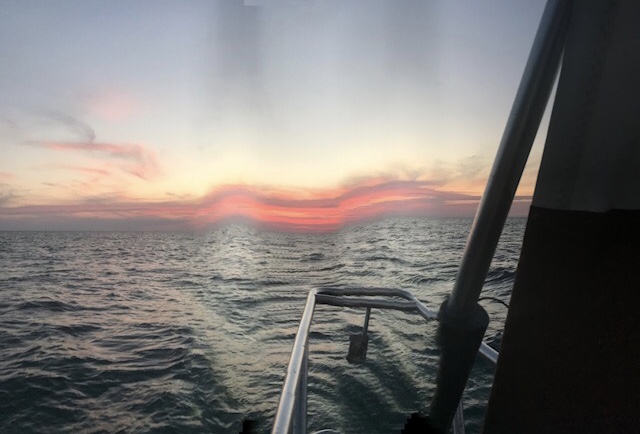
When you head back to the States this time of day you are literally "sailing into the sunset" as the saying goes. It was a poignant moment and I savored every bit of it. 


The first 6 hours of my sail to the shoals were the ultimate sailing experience... warms temps, sunny skies, and steady breezes pushing me directly into the sunset. I was ecstatic. I sang songs and danced on the deck while trolling my favorite green skirt fishing lure. 

Before long the fishing reel started screaming and another fish was about to come aboard. Yep, I had caught  another big Mutton Snapper while trolling behind the boat. What a great omen and blessing. 
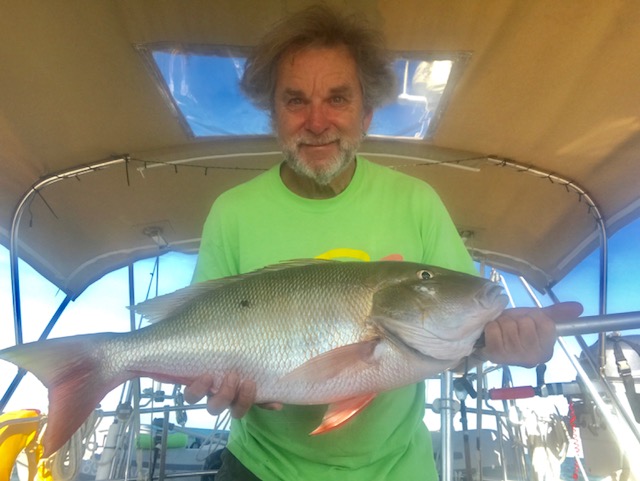
Everything was perfect and I was high as a kite on adrenaline. I rode on the bow of the boat giving thanks to God as I drew closer to the end of a wonderful journey.
Click the link below to view a short video about my departure and my mutton snapper:

Crossing the Gulf Stream  Sailing With Joe video


I considered putting this fish into the fridge whole but then I said, what the heck. I might as well clean him now and be done with it.  So here is my big cabin table prepared for surgery of this monster fish.  Ten nice sized snapper steaks were soon filling my freezer/fridge. 


As I grew closer to the Manatilla shoals the winds began to increase. 15knots had increased to 20 and then 25 knots. The fetch of the seas seemed to get worse.  By the time I arrived at the shoals at 10:30 pm the conditions had worsened even more.  It was dark as smut and the chop was getting even more uncomfortable. I was not dancing anymore at this point.

Conditions were not great to anchor but there was not much choice. I wanted to get some rest before the big day ahead of crossing the Gulfstream back to the states. So down went the anchor in rough seas. 


Conditions soon worsened even further. I tried but sleep was just not possible.  The boat rocked and rolled in the night, and I felt more like a cork bobbing in a washing machine than the peaceful anchorage on the banks I had envisioned.  

I paced.  I pondered. I prayed. I wondered what I would do. Serenade continued to rock like a bucking bronco. She desperately tried to set herself free of the anchor that held her to the floor of the sea.   As midnight passed I was convinced that sleep was not going to happen and I would be better off to just start sailing into the dark abyss of the Atlantic towards America.  

It was 1:30 in the morning when I made the decision to weigh the anchor and leave the Bahama banks far earlier than planned to head out to sea into the pitch black night. 


But by now the seas were so rough that I dreaded the thought of crawling onto the salt sprayed deck to raise the anchor in these conditions.  The bow of the boat rose and fell in the night but there was no other choice but to get started.  I donned my life jacket, safety harness and tethered myself in.  

I nervously clipped my harness into the jack line and carefully crawled my way to the bow of the boat to raise the anchor.  Releasing the snubber line on the anchor rode would be the first order of business. It turned out to be a daunting task. 

As much passion as I have for single handling, the one area that is most difficult by yourself is to retrieve an anchor during rough seas.  There is so much tension on the anchor chain that it is nearly impossible to crank it into the boat under such tension.  So in order to get the anchor up you have to create some slack in the anchor chain.  This means crawling back to the cockpit and using the engine power to steer forward in small increments to create some slack in the anchor chain so you can begin to crank it in.  

This maneuver took a series of 4-5 trips back and forth from bow to cockpit in order to get the chain reeled in.  Each trip I am adjusting my tether line which is the only thing that keeps me from falling overboard should I lose my footing or be hit by a rogue wave. 

No one in their right mind goes on deck in these kinds of conditions without being harnessed in securely.  I was literally crawling on the deck that night taking every precaution not to lose any grip of my footing or hands.  

Finally the anchor was up and secured to the bow sprit. I breathed a sigh of relief. The stress on the boat's anchor and bow roller had been intense. Little did I know tomorrow I would discover damage to the bow roller. Clearly, the strain on the ground tackle from the constant rise and fall of the boat during high seas was too much.


Now that the anchor was up it was time to get my bearings and figure out which way to go to get this baby moving out to sea. Thankfully Serenade is an Island Packet, I thought to myself. They are built like tanks and can take these kinds of conditions. 


So here I am, finally on my way as the boat crashes through the waves searching for a heading.  At night you can only depend on your instruments to guide you and the Garmin plotter soon had me back on course in a matter of minutes. 

Next order of business was to raise sails or at least the mainsail. Even in hazardous conditions I have found that having at least one sail up tends to stabilize the lateral movement of the vessel making it easier to steer. Having a sail up seems to tame her a bit. 


In order to raise a mainsail you have to point the bow directly into the wind so you can hoist the sail without it getting snagged on the spreaders or the shrouds.  So here I am, I got her pointed into the wind and I use the winch to crank the sail to the top of the mast.  Now I can better manage the vessel with use of this sail in the event there was ever an unexpected engine failure. "Don't even go there." I tell myself. 

Serenade and I slowly make our way towards the edge of the shoal when it suddenly occurs to me that I had not even thought to reef the mainsail. What was I thinking?! It wasn't on my radar to do in advance because the afternoon winds had been so mild in the glow of that April sunshine. Reefing means reducing the area of the sail.  It is done for extreme winds where less sail up is the safer alternative.

There is nothing worse than to have too much sail up in case the winds speeds increase later.  If that happens you could be screwed. Always reef early. 

At this point I collect my thoughts and decide that I really should reef her down before I step off the edge into the deep unknown of the Atlantic.  Reefing is the last thing I want to do at this point but I know it is the smart thing to do.  


In these rough conditions, this would prove to be an arduous  feat. But after my ordeal to get the anchor up, what's another tough task in the night?  So here it is 1:30 in the morning when I take a double deep breath and begin the process to reef the main.  This means dropping the main sail partially down, then climbing onto deck to tie off 3 separate reef lines that will secure the loosened sail to the boom.  Easy enough in calm seas.  Quite a different story under these conditions. 

Tethered in, I crawl onto the deck and tie off three reef knots while lying on my back or sitting on my knees.  Thankfully the auto pilot does a pretty good job of keeping her headed into the wind at a slow speed while I complete the tying of the reef knots.  By now my knees are getting rubbed raw because I refuse to stand upright on the deck while the boat is in such an erratic fit bouncing up and down violently in the night.   

Wallah! Finally!  
The last reef knot is tied! Next I use the winch to tighten the back haul which tightens the reefed main to the boom.  Then I use the winch again to raise the mainsail to its altered height on the mast... mission accomplished.  Sail area reduced. 

It's not the prettiest reef job in the world but it will do.  Now I am ready for the Atlantic. Or as ready as I can be. 
Finally underway!

Much to my chagrin the weather forecast for south winds is not holding true.  Instead, I am faced with 20 knot winds coming straight out of the west.  My only choice is to head due north. My plan is to maintain a north heading with a gradual shift to the west. Sails are tight hauled in order to point as close into the wind as she will allow.   

After a few hours of this north heading I realize my 12 hour passage west to Fort Pierce is now only a dream.  Ain't gonna happen.  So north it is! Onward!

By dawn I have made some north progress but practically zero progress westward toward Florida.  Time passes on and by early afternoon I notice I am drifting too far to the east.  At this rate I will be more likely to find England than the Florida coast!


 When I check the bow I discover the toll last night's rough weather has taken on the bow roller.  Notice in the photo above how the hardened stainless steel of the right side roller has been severely bent to the left.  The force it took to bend that metal is beyond me.  Since I won't be anchoring anytime soon I put that worry into my back pocket for another time. Carry on I say.


Around noon a spooky feeling comes over me.  As frigate birds fly above me, I now realize that I am still 75 miles from any Florida shoreline and there will be no way I can possibly make a landfall in daylight hours.  For once I feel all alone and a little nervy. 

With strong west winds still in control I make an executive decision to drop sails and use the engine to motor due west into the chop.  The best speed I can make into the wind is 4.5 knots but I forge ahead.

After changing course I found myself lost in thought staring blankly into the open sea ahead when suddenly something happened that was a first for me.  

Out of nowhere a huge whale crosses directly across my path no less than 20' off my bow. It happened so fast I had to ask myself, "Did I really see that?!"  Yes, I did. My first whale siting.  He was too close for comfort too. 

It was like he breached in front of my bow in an flash and then went right back down never to be seen again.  My spooky feeling from earlier just got spookier.  Although they mean no harm, there are stories of whales colliding with boats.  Rudders broken off or hulls being cracked. Boats even going down. 

It all happened so fast but I figure it must have been an Atlantic right whale as shown in this google image.
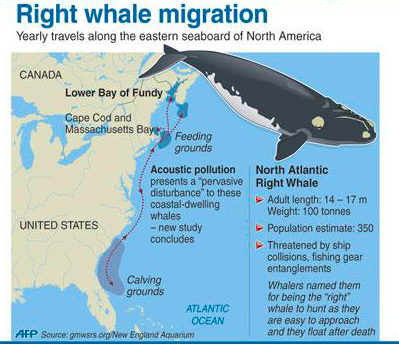


This image is identical to the creature I saw so near my boat.


At this point I realized this is serious stuff out here.  I decided I should go below and rethink things.  Just to make sure, I checked my emergency "ditch bag" to be sure it was stocked properly with emergency supplies ready to deploy on short notice.  Next, I tested the EPIRB (emergency locater beacon) and stowed it back into the ditch back along with 3 gallons of water and other various and sundry things in the event of abandoning ship in a dire emergency.

I decided to consider the whale crossing a good omen rather than any fear element.  I continued motoring into the west for several more hours with only the mainsail up. Before long I was making better speed and getting ever closer to the Gulf Stream.  The winds were becoming a steady 15 knots out of the south now and I was able to kill the engine. 

The Gulfstream is an oddity to me.  Yes, it is like a river flowing north within the Atlanta Ocean.  I have crossed the Gulfstream 3 time previously, and each time I had to wonder just exactly when I arrived in the stream.  For this, my 4th crossing, there was no doubt. The Gulfsteam had found me.  

The color of the sea became a rich hue of blue like none other I'd seen and had sort of an oily appearance to it. Evidently I was now criss crossing the Gulfstream making about 5 knots.  I thought to myself, "What if I turn my vessel due north now and go with the flow?"  

Sure enough, with the ever slight turn of the helm my speed immediately increased from 5 to 9 knots.  I was definately in the Stream now, even hitting speeds of 10.5 knots.  

Riding the current of the Gulfstream is like no other sailing I have known.  It is truly amazing to feel and experience sailing in such a rapid current.  I made  a fast 60 miles north in about 7 hours. Suddenly it seemed like progress was in the works as the Florida coast was now only about 40 miles to my west. 
Hauling ass on the Gulfstream
With this great weather and speed in the Gulfstream it was tempting to consider continuing on sailing for another all nighter.  But I was tired and I didn't know how much energy I could muster for another night and day without sleep.  I had taken short cat naps during the day, but that is no substitute for real sleep.  So after about 6 hours riding the current, I altered course and redirected my ship due west for Port Canaveral.  The 40 miles west seemed like an easy enough feat even though I would arrive long after dark.  Little did I know what was in store in the remaining miles to Florida.
A friendly hitchhiker
The final leg to Port Canaveral started out great.  By now the wind had finally clocked more from the south and I was able to make good time on a broad reach point of sail crossing over the Gulfstream instead of running with its current.

Dusk settled in and the winds picked up a little more as did the size of the swells. Soon I was riding a following sea and making great time getting nearer and nearer to my goal.  I didn't like the idea of entering an unfamiliar port in dark but there was no choice but to carry on.

Soon cruise ships were visible exiting the port as they carried their customers to the exotic islands that I had left behind.

Winds increased to 25 knots and I held on as Serenade sliced through the waves. I was running an even broader reach now with the mainsail sheet almost fully extended.

Soon the city lights of the mainland became visible on the horizon.  Closing in on 5 miles from the port entrance I decided to drop sails now rather than fight that battle so close to land in these kind of seas.  Besides, the winds were not letting up and getting sails tucked away for a port entrance would take some skill and stamina that I was growing short on in my tired state. 

The final 3 miles in the night to Canaveral were the most challenging.  Waves crashed into the beam of the boat and salt spray covered the decks.  Soon I would make it to the first set of red and green channel markers.  Thank God no ships were exiting the inlet as I neared.  Bang! Another wave. Bang! Another wave! I held on and forged ahead. 

As I carefully threaded the needle between the red and green markers the lights of Port Canaveral grew brighter. Thank God for instruments to steer by.  I radioed ahead to see if I could tie up to a fuel dock at a marina there.  The marina was closed but some fellow granted me a yes.

Finally, within a half mile of the rock jetties of the port entrance a rogue wave came out of nowhere to clobber me on the port beam.  I saw it coming and braced myself for the biggest one yet.  With this collision between water and fiberglass I noticed my dinghy had become untethered and was flailing about from the davits that held her.  The last thing I wanted now was to lose my dinghy at a time like this so close to port.  

Conditions did not allow me to free my hands from the wheel or I would've re-secured the dinghy.  Luckily she did not fully detach yet but I couldn't be sure.  

Within minutes I entered the calm waters behind the sea wall and took a huge deep breath of relief.   The dinghy was dangling from the stern barely in tact, wobbly but not lost! Yay! 

Once behind the sea wall suddenly everything was calm and peaceful. What a contrast I thought.  It had not been the most graceful entrance into Port Canaveral at 11 pm, but I was safe and grateful to be here.

Ever so slowly, I motored a mile in the calm protected waters making my way to the well lighted dock at the marina. By now docking my boat into the outgoing tide was the least of my worries.  I swerved her smoothly into a starboard tie up by making a gentle 180 degree turn that landed her perfectly to the dock, cleat to cleat, for a welcome respite.  

A rock band at the local bar blared loudly but I did not even care.  No one in the crowded bar had a clue I was here or what I had just been through. I was exhausted and I collapsed in the spirit of blissful relief for brief moment.  

But I was still wired from the adrenaline and sleep seemed secondary for now.  So at midnight I spent the next hour hosing down Serenade with the marina's high pressure water hose.  My lady was soon free of all the salt spray she had taken on for me.  She would greet the dawn clean and ready for the next nautical mile ahead of us both.  Mission accomplished. 

The crossing turned out to be 175 miles in 32 hours instead of the 70 miles in 12 hours I had planned. In total, Serenade had taken me 1255 nautical miles since departing St. Pete 60 days ago. 

I would have sweet dreams tonight. 
Tomorrow I would wake up in America.


Sunday, March 18, 2018

Episode #1 - What Is Sailing To Serve?

(All previous blog postings from Glory Days can still be viewed at SV/Glory Days)


“The purpose of life is not to be happy. It is to be useful, to be honorable, to be compassionate, to have it make some difference that you have lived and lived well.” 
― Ralph Waldo Emerson

My new home, SV/Serenade

Sailing To Serve - How it began:

"Sailing To Serve" = Paying it forward in a marine environment.  Let me explain.

I feel very fortunate to own my current vessel, an Island Packet 35 that I lovingly call Serenade. As I prepare now to embark on an extended period of cruising aboard Serenade, I am humbled and grateful that circumstances have aligned which allow me to pursue the cruising lifestyle.  I bask in gratitude which has led me to initiate the concept of Sailing To Serve.

Sailing to Serve has become my personal philosophy to intentionally give back to the universe for all the blessings I embrace wholeheartedly. I am not a wealthy yachtsman by any means. I buy used boats and pour my heart into them. I fix most everything myself and I inherited my Dad's thriftiness and do-it-yourself philosophy. 

I never ever want to view the cruising lifestyle as a self indulgent means to see the world. There is more to than that.  I get to do this, hence I am called to serve. 


As I enter new ports of call it has become routine to see the sights, tastes the foods, meet the locals while trying to contain my giddy gratitude. As I proceed in this mission it has become my mission to always seek out ways to serve others by paying it forward while in new ports of call. 


In the spirit of Sailing to Serve I initially committed myself to purposely seeking out at least one random act of kindness each day. I've had some success doing such.  But idealistically as that may sound, I found it quite challenging to complete such a feat of random kindness on a daily basis.  Still, I keep that concept at the front of my heart although I don't always meet the mark.


During my career, I worked hard as a school teacher before retiring in 2012. Retirement has set me free again and has allowed me to get to a place where I can now openly explore the world amid the excitement, risks, and uncertainties that are all a part of the sailing lifestyle.


Ghandi said "Be the change you want to see in the world." Sailing to Serve will continue to be my personal method to complete that mission. I am the change.  This has opened my eyes to the many blessings in my world as well as the not so great plight I have witnessed in others along my travels.


Sailing To Serve is an evolving concept that I ponder often.  It's an open ended ray of light that just happens to set its own tone given the proper mindset and desire to be a servant of mankind.  It grows everyday but here are some typical opportunities I see in Sailing Serve :

Be Open:  Keep a watchful eye for those in need whether they realize it or not.  Be open to getting outside my comfort zone whenever and wherever the opportunity arises.  Take risks, extend a hand, extend an ear, make things happen that need to happen. Everybody is going through something and some are reluctant to share it. Listen.

Service Through Volunteering.  Offering help in any situation serves everybody whether they ask for it or not. Going out of your way to size up a situation and quietly making a difference is appreciated even if not noticed or rewarded. Volunteering can be as simple as holding a door for a stranger or recognizing a need most anywhere you go... It could be at an anchorage, a library, a street corner, a grocery store, a bar, a church, anywhere at all where a need is present.  Sometimes you have to look hard. But keeping ones' eyes open to the unabashed need around you is a full time job. When you see it don't let it slip away. Act. 


Serving Homeless.  Unfortunately, these people seem to be far too many in my travels.  It's a sad plight in our society and I wrestle with how to do my part while encouraging success without fostering the epidemic.


Each homeless person has a different story and it's the kind soul who will see them as decent people, greet them and recognize them at every opportunity.  Little tricks like surprising them with food or clothing creates a glow to remember. It's easy to ignore panhandlers and homeless people because we are often are afraid to engage with them.  Even just a friendly acknowledgment of themselves as a worthy person goes a long way. I feel their pain although my life is so far removed from theirs. Each of them has their own story and path of hard knocks, bad decisions and just unexplainable karma. Who am I to think of them as a weed with no purpose? 


I've yet to offer a visit or sail on my boat to a homeless person but I don't rule it out. There's still areas that I am growing in slower than I would like to admit.


Serving Up Smiles. Everybody I meet or cross paths with gets a free smile. Strangers, children, pets, policemen, clerks, servers, even assholes. Smiles melt barriers and invite good will. Don't ever let a day slip away where you don't smile out loud. It's all a part of Sailing to Serve. 


Serving through Music.  Whether it be street singing or playing some tunes for children or the elderly, music is an international language.  Songs I write and people I play for are really more like gifts to myself.  Music heals and opens up hearts and I do my best to give freely through music. Open mics are a great way to meet folks in a new town and a great way to identify hidden needs in others.  Don't hold back. Give freely. 


Serving Through Secrets. Sometimes serving others is not intended to be openly displayed.  Unique opportunities often present themselves where we can be an instrument of love to others who never even knew we had a part in it.  These are my favorites. Again no party is exempt or left out of the possibilities. Service can and should be undercover sometimes. I don't need to pat myself on the back to validate anything.  Go undercover. 

Serving With Kindness. Be humble and kind in all situations and your light will shine into others. Kindness is contagious. I believe Kindness is only second to love in God's eyes. There's always room to add more love. I love this song:
Humble and Kind by Tim McGraw

Serving by Helping Out.  Whether it be picking up trash that is not yours or just leaving things better than you found them you have made a difference. There's no room to let up here. Always pitch in more than your share. It'll work out. Always does. 

And last but not least Serving The Sea.  Conscious environmental stewardship is a service to the entire world.  There's so many avenues to express your part for healing the sea one day at a time.  Treating our mother ocean like the precious jewel she is starts with little things that everybody can do. The ocean is the vast frontier that feeds us and transports us physically and spiritually. 

I can only do my part and lead by example.  One by one we will get there through service to the sea.

There are no limitations, restrictions or judgements as to who, what, where or when service can be rendered.

Service is noble and selfless and each of us is called if we can only stop and listen. It is wide open as long as there is a will in the heart and a desire in the soul and patience for it all to unfold in the perfect plan. 

In conclusion, Sailing to Serve is hard for me to really define.  It is still evolving and I make a point to allow it to flow seamlessly into whatever direction I am called. How to better serve others is the unfolding and sustained mission of my little concept called Sailing To Serve.   


I am here now and my time on this earth is not quite what it used to be. I realize most of my life is over. Therefore my purpose has to be intentional, sensitive, empathetic, alert and open to recognizing a personal or community need and to act on it without hesitation or thinking only of myself. I expect nothing in return. 

  
My dad lit the spark in my heart that I embrace through sailing.  It's the least I can do to think less of my blessings and more towards the needs of those who did not have the ideal childhood and life I have been blessed with. 

Sailing to Serve is simply my philosophy for a selfless mission. I am blessed beyond words and I must do my part to gratify my blessings whatever it takes.


And if I am lucky, at the end of the day, I get to go back to the comfort and magic of my own sailing vessel home where another of God's incredible sunsets will be displayed. And another morning to serve will be God's gift to me. 


“No one has ever become poor by giving.” 
― Anne Frank, diary of Anne Frank: the play


So How did it start???


Everything starts with something. A Genesis.

The sailing bug bit me sometime during my late teenage years and it has never let go. I have to credit my Dad for that.   


Growing up in a small rural community in Georgia was a blessing in itself.  But to have youthful parents who raised us on the water was an extra bonus.  I recall a long series of  modest power boats during my youth before Dad decided to take up sailing later in his life. That was the beginning of a love relationship between me and the wind.


The first time I felt that summer breeze move our little boat atop the water, I was immediately hooked. Neither Dad nor I knew diddly squat about sailing when he purchased a small sailboat for us to use on Georgia's Lake Lanier. But that didn't stop us from figuring it out. 


My Dad. The boat was appropriately named Genesis. 
You have to understand that my Dad was raised from simple means on a farm.  He was also a very generous and giving man. As a child of the depression let's just say  he was known to be quite "thrifty" with his money.  That is probably why he made some timely and wise investment decisions that allowed us a happy childhood messing around with boats, lots of fishing trips, and mentoring us to develop a real love for nature.

At the time Dad bought the first sailboat we teased him because everybody knew he bought a sailboat since the wind is free and there would be no fuel to purchase! 

Cha-Ching! 

And so we learned sailing by trial an error although we did receive a couple of basic lessons from an elderly neighbor, Mr. Buck. This neighbor understood the zen of sailing and the hook was immediately set for a bright eyed high school kid like me. 


Suddenly tricking the wind to gracefully move a chunk of fiberglass across the water sparked a fire in me and continues to resonate as one of my deepest passions 50 years later.


My Dad, Harold Green.  "The Man with the Plan."
It's true I have enjoyed a relatively privileged life in many ways and I suppose boating is just one example of how I have been blessed. That's why I've always felt the need to give back, or nowadays I just call it Sailing to Serve.  You can google it!

Our family continued to sail a few different boats on Lake Lanier while honing our sailing skills through a long series of screw ups and mistakes on the water. Things like wildly swinging booms, uncontrolled jibes, runaway jib sheets and snapped shackles were just a few of the mishaps that trained us for the patience and planning required in sailing.  Sometimes it only takes a certain mistake one time to head it off from ever occurring again. Like loosing your grip on the main halyard as it gets pulled to the top of the mast is a mistake you'll only make once. 


Before long we got better at it, and the quiet beauty of a gentle broad reach soon became just as exciting as water pouring in over the gunnels while beating into a stiff head wind to clear a rocky shoreline on a single tack. 


I like to think dear old Dad would be proud that I have carried on the sailing tradition that he planted within me.  I like to think he's at the helm with me now as I cross inlets and oceans chasing new discoveries that grow within me and outside me. 


We miss you Dad.  Love always.
After college and in my mid 20's, I had the unique opportunity to crew aboard a 41' sailboat on a 23 day Pacific passage from California to Hawaii. Ever since that trip I surrendered to the dream to one day have my own sailing vessel and cruise aqua seas at will.  I was never the same after that trip. Here's some pics from the early 80's when I sailed to Hawaii.


For the next 3 decades I worked an enjoyable career as a horticulturist and passionate school teacher.  And during all those years of employment I immersed myself into studying for my life long dream of sailing. Voraciously, I read all the cruising magazines cover to cover. I spent summers chartering sailboats and crewing with friends. 
This early boat was called The Little Professor
 Through the years I owned several small sailboats from trailerable ones to coastal cruisers. Six sailboats later I purchased my first ocean cruiser, Glory Days, a Pearson 33. Damn good boat she was. She carried me safety over 5000 miles and to countless memorable anchorages that furthered my desire to explore the coasts in my own vessel.
SV/Glory Days
She was a very able vessel and the things I learned while outfitting her are invaluable. Suddenly you have to become an electrician, a plumber, a mechanic, a carpenter, and a navigator. Glory Days took me safely to my first trip to the Bahamas as a single handler.

Still, as good as she was, I felt the need to upgrade one more time after four years and 5000 miles sailing together. 

Glory Days - Pearson 33 - what a boat she was.


Suddenly I found myself in a similar position as my Dad when my daughter came to visit me on Glory Days in the Bahamas.  It's a parental thing I suppose!


Glory Days in Bahamas 2014
It was a bitter pill to swallow when a buyer came along for Glory Days. It occurred about the same time I got my heart broken in love which made for a boatless, loveless, and what seemed like hopeless summer.  (I'm much better off now though even if I couldn't see it at the time.)

Since this is the first post on my new blog for SV/Serenade I hope you'll follow future posts if you are inclined.  All 109 action packed blog posts from my former love, Glory Days, can be viewed at this link:

Sailing Vessel Glory Days


Bigger, better, faster, more led me to my next boat, an Island Packet 35.  Stay tuned please.


EPILOGUE:

Tonight at 2200 hours I pull up the anchor and begin my trek  148 nautical miles towards Bullock Cay in the Bahamas.  I'll buddy boating alongside two chaps I met yesterday in their boats.... Stay tuned for Episode 2.... onward.

(All previous blog postings from Glory Days can still be viewed at SV/Glory Days)